Machine Learning on LE via Jupyter
Overview
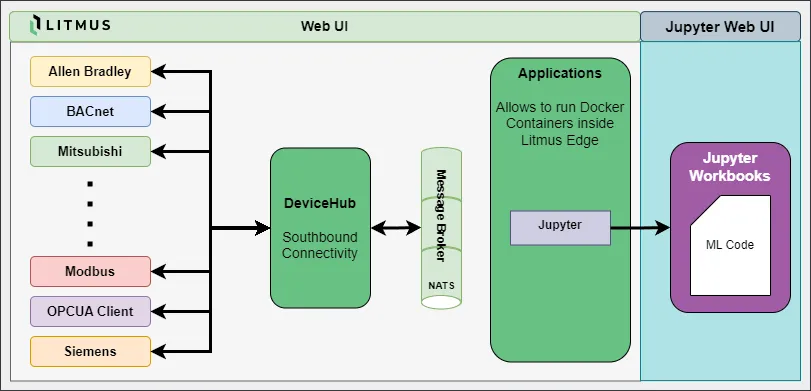
This solution describes how to run a machine learning application using Jupyter on Litmus Edge. After deploying the container, you will be able to log in to a Jupyter notebook environment running on your LitmusEdge device and use the bundled example notebooks for classification, anomaly detection, and prediction.
Prerequisites
- A running Litmus Edge instance with administrative access.
- The Jupyter ML toolkit image (.tar.gz) provided by Litmus.
- Network access to the Litmus Edge IP from the machine you will browse from.
- SSH access to the Litmus Edge host (used once to retrieve the Jupyter login token).
Step 1: Download and prepare the image
Obtain the Jupyter ML toolkit .tar.gz file from the Litmus repository or release artifact provided to you.
Step 2: Upload the image to Litmus Edge
- Log in to your Litmus Edge instance.
- Navigate to Applications > Images.
- Upload the .tar.gz file downloaded in Step 1.
Wait for the upload to complete and confirm that the image appears in the list of available images.
Step 3: Configure and run the container
- Navigate to Applications > Containers.
- Create a new container using the image uploaded in Step 2.
- Use the following docker run command:
docker run -p 8888:8888 \
  -v /var/lib/loopedge/analytics2/models/:/home/loopedge/work/notes/savedmodels \
  <imgname>:<tagname>
This command:
- Exposes the Jupyter application on port 8888.
- Mounts the LitmusEdge analytics models folder into the container at /home/loopedge/work/notes/savedmodels, so any models saved from a notebook are immediately available to the Analytics engine.
Step 4: Open the Jupyter application in a browser
In a new browser tab, navigate to your Litmus Edge IP address followed by port 8888:
http://<le-ip>:8888
For example, if your Litmus Edge instance is at 10.17.10.27, open:
http://10.17.10.27:8888
You will be redirected to the Jupyter login page, which prompts for a Password or token.
Step 5: Log in to Jupyter
5.1 Retrieve the access token
The Jupyter container generates a one-time token at startup. To retrieve it:
- SSH into the Litmus Edge host.
- Find the running Jupyter container:
docker ps | grep jupyter- Read the token from the container logs:
docker logs <container-name> 2>&1 | grep -oE 'token=[a-f0-9]+' | head -1You will see output similar to:
token=8968cc8cf0480ed3b2b52c25fed0eb527f7ea2fc888b4ea- Copy the value after token=.
5.2 Log in using one of two options
Option A: Log in with the token (one-time)
Paste the token into the Password or token field at the top of the login page and click Log in.
Option B: Set a permanent password (recommended)
On the same login page, scroll down to the Setup a Password section:
- Paste the token into the Token field.
- Enter your chosen password in the New Password field.
- Click Log in and set new password.
You will be logged in and the password will be saved for future sessions, so you no longer need to look up the token.
Step 6: Use the bundled notebooks
Once logged in, you will see the Jupyter file browser. The following example notebooks are included under /home/loopedge/work/notes/:
- natsConnection.ipynb - Example of connecting to the LitmusEdge NATS broker.
- influxConnection.ipynb - Example of querying InfluxDB on LitmusEdge.
- classification.ipynb - Example classification model.
- anomaly.ipynb - Example anomaly detection model.
- prediction.ipynb - Example prediction model.
- template_prediction.ipynb - Template you can copy as a starting point for new prediction models.
Models saved into /home/loopedge/work/notes/savedmodels from any notebook will appear automatically in the LitmusEdge analytics engine, thanks to the volume mount configured in Step 3.
Troubleshooting
The "enable a password" or "the documentation on how to enable a password" links on the Jupyter login page return a 404. This is a known issue with the upstream Jupyter login template, which references documentation URLs that have since moved. Use the Setup a Password form on the same login page (see Step 5.2, Option B) to set a password without needing the linked documentation.
docker logs does not show a token. The container may have been started with JUPYTER_TOKEN set to an empty value, or with token authentication disabled. Restart the container without overriding JUPYTER_TOKEN, or set it explicitly using -e JUPYTER_TOKEN=<your-chosen-token> in the docker run command from Step 3.
Browser cannot reach <le-ip>:8888. Verify that port 8888 is published in the container configuration in Step 3, that the LitmusEdge firewall allows inbound traffic on 8888, and that your browser machine has network access to the LitmusEdge IP.