Kepware to LitmusEdge Migrator
Overview
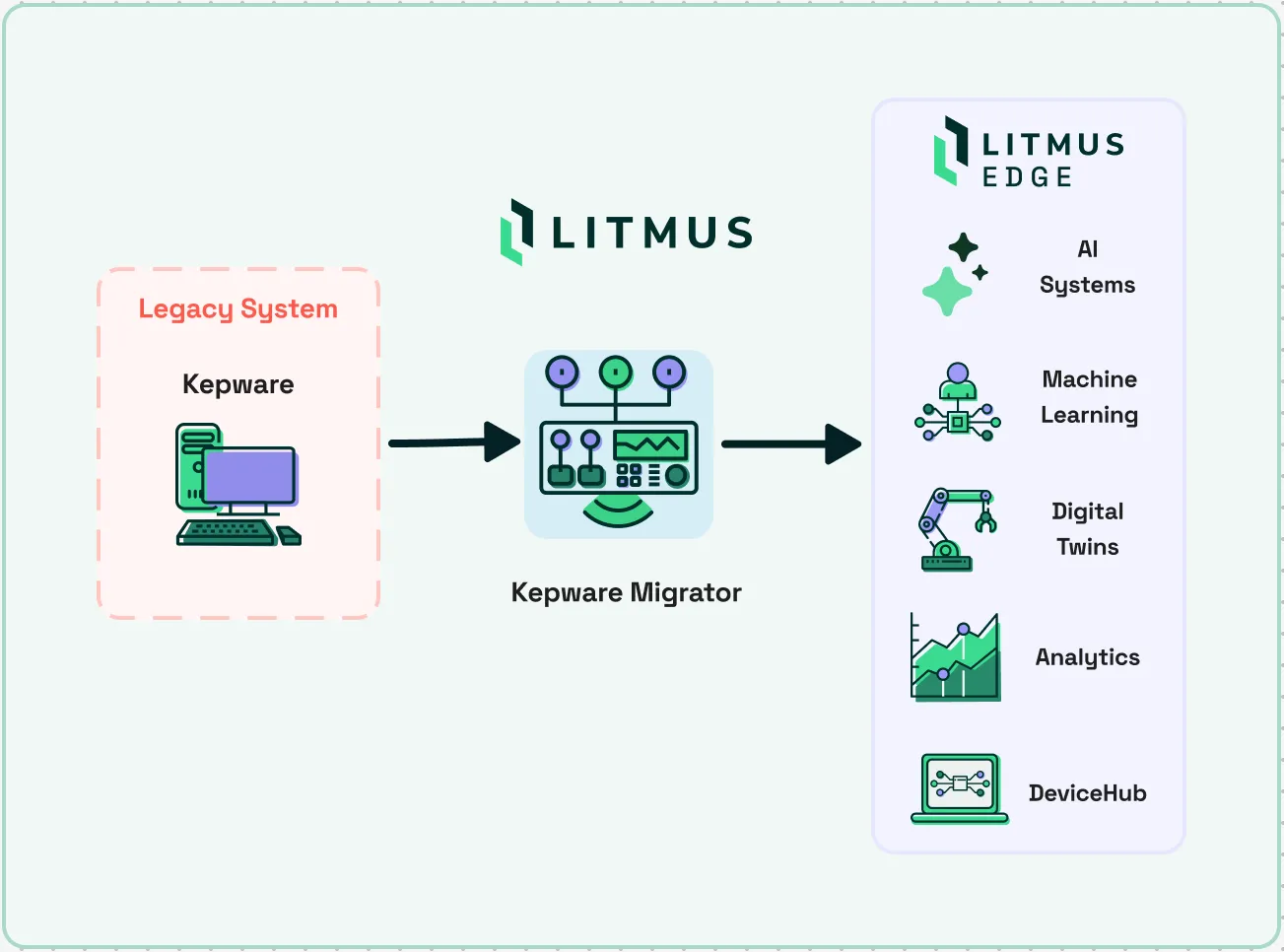
The Kepware to LitmusEdge Migrator is a web-based tool that automatically converts Kepware project files into LitmusEdge-compatible format. The migrator analyzes Kepware JSON exports and performs intelligent transformations including driver mapping, address translation, and configuration preservation.
Key capabilities:
- Automatic driver mapping from Kepware to LitmusEdge equivalents
- Address translation for Modbus, Siemens, Allen-Bradley, and Toyopuc protocols
- Web-based interface for file upload and processing
- Direct template application to LitmusEdge instances using OAuth2, an API token, or username and password
- Detailed migration logs with unmapped address reporting, exportable as text or HTML
- Light and dark themes
Supported Drivers
Kepware Driver | LitmusEdge Driver |
|---|---|
Modbus TCP/IP Ethernet | Modbus TCP |
Siemens S7 Plus Ethernet | Siemens S7CommPlus |
Siemens TCP/IP Ethernet | Siemens S7 |
Allen-Bradley ControlLogix Ethernet | AB CompactLogix Ethernet Advanced |
Allen-Bradley CompactLogix Ethernet | AB CompactLogix Ethernet Advanced |
Allen-Bradley MicroLogix Ethernet | AB EthernetIP Ethernet |
Toyopuc PC3/PC2 Ethernet | JTEKT Toyopuc CMP-Link |
Fanuc Focas Ethernet | Fanuc Focas (Coming soon) |
Install
Prerequisites
- Litmus Edge version: Litmus Edge 4.4.x. Needed only to apply templates directly; downloading the converted JSON works without a Litmus Edge connection.
- Docker installed on the host. The image is built for linux/amd64; arm64 hosts are not supported.
- Port 4001 free on the host, or another host port mapped to container port 4001.
- Network access from the container to the Litmus Edge instance at EDGE_URL.
- Litmus Edge credentials for direct template application: an OAuth2 API client (client ID and secret) or an API token, created in Litmus Edge.
- Kepware project exported as a JSON file.
Step 1: Download and Load the Image
- Download kepware-migrator.tar.gz from the Litmus Central Portal.
- Load the image:
docker load -i kepware-migrator.tar.gzDocker prints the name of the loaded image:
Loaded image: us-docker.pkg.dev/litmus-customer-facing/litmus-solutions/kepware-migrator:latestUse this name in the commands below. The image is already on the host after docker load, so nothing is pulled from a registry.
Step 2: Run the Container
Run the migrator without a Litmus Edge connection (configure it later on the Config page):
docker run -d -p 4001:4001 --name kepware-migrator \
  us-docker.pkg.dev/litmus-customer-facing/litmus-solutions/kepware-migrator:latest
Or pass the Litmus Edge connection at startup with OAuth2 client credentials:
docker run -d -p 4001:4001 --name kepware-migrator \
  -e EDGE_URL=https://192.168.1.100 \
  -e EDGE_AUTH_METHOD=oauth \
  -e EDGE_API_CLIENT_ID=your_client_id \
  -e EDGE_API_CLIENT_SECRET=your_client_secret \
  us-docker.pkg.dev/litmus-customer-facing/litmus-solutions/kepware-migrator:latest
To use an API token instead, set EDGE_AUTH_METHOD=token and EDGE_API_TOKEN=your_api_token in place of the client ID and secret. The values can also be kept in a file and passed with --env-file kepware-migrator.env, one KEY=value per line.
Values
Variable | Default | Required | Description |
|---|---|---|---|
EDGE_URL | none | Yes, to apply templates | Litmus Edge URL or IP. HTTPS is assumed if no scheme is given |
EDGE_AUTH_METHOD | oauth | No | oauth, token, or jwt (username and password) |
EDGE_API_CLIENT_ID | none | For oauth | OAuth2 API client ID |
EDGE_API_CLIENT_SECRET | none | For oauth | OAuth2 API client secret |
EDGE_API_TOKEN | none | For token | API token generated in Litmus Edge |
EDGE_USERNAME | none | For jwt | Local Litmus Edge username |
EDGE_PASSWORD | none | For jwt | Local Litmus Edge password |
The same values can be set later on the Config page. Values saved there are written to a .env file inside the container and take effect immediately.
Step 3: Verify
- Open http://localhost:4001. The migrator home page loads; curl -s -o /dev/null -w '%{http_code}' http://localhost:4001/ returns 200.
- Check the logs:
docker logs kepware-migratorThe log ends with Uvicorn running on http://0.0.0.0:4001 and shows no errors. Without a .env file, the line Did not find .env file in current working directory. Defaulting to system variables is expected.
Before Applying a Template
Warning: Applying a template replaces the DeviceHub configuration on the Litmus Edge instance. Existing devices and tags that are not in the template are removed. Back up the current configuration first by downloading the existing template from System > Device Management > Template in Litmus Edge.
Remove
docker rm -f kepware-migrator
docker rmi us-docker.pkg.dev/litmus-customer-facing/litmus-solutions/kepware-migrator:latest
Removing the container also removes the .env file written by the Config page and any uploaded or processed files. If you created a local env file for --env-file, delete it as well. Confirm nothing is left with docker ps -a --filter name=kepware-migrator and docker images | grep kepware-migrator.
Using the Migrator
Step 1: Export Kepware Project
- Open Kepware Configuration Manager
- Go to File > Save As
- Select JSON format
- Save the file to your computer
Step 2: Upload and Convert
- Navigate to the migrator home page at http://localhost:4001
- Click "Choose File" and select your Kepware JSON file
- Click "Upload"
- Wait for processing to complete (typically a few seconds)
Step 3: Review Results
After processing, a new entry appears under Recent Upload Activity. Click it to expand the details:
- Unmapped Kepware Addresses: tags that could not be converted, with the address and the reason
- Successful Migration Summary: the converted channels and the devices under each one
Use Copy Logs or Download Logs to keep a record of the migration. Logs are stored in your browser, and Clear Logs removes them.
Step 4: Download Converted Configuration
- Scroll to the "Processed Files" section
- Click "Download" to download the LitmusEdge-compatible JSON
Use the delete button next to a file to remove it from the migrator.
Step 5: Apply to LitmusEdge
Option A: Direct Application (Requires Configuration)
Note: The "Apply to Litmus Edge" feature only works after you configure your LitmusEdge connection on the Config page.
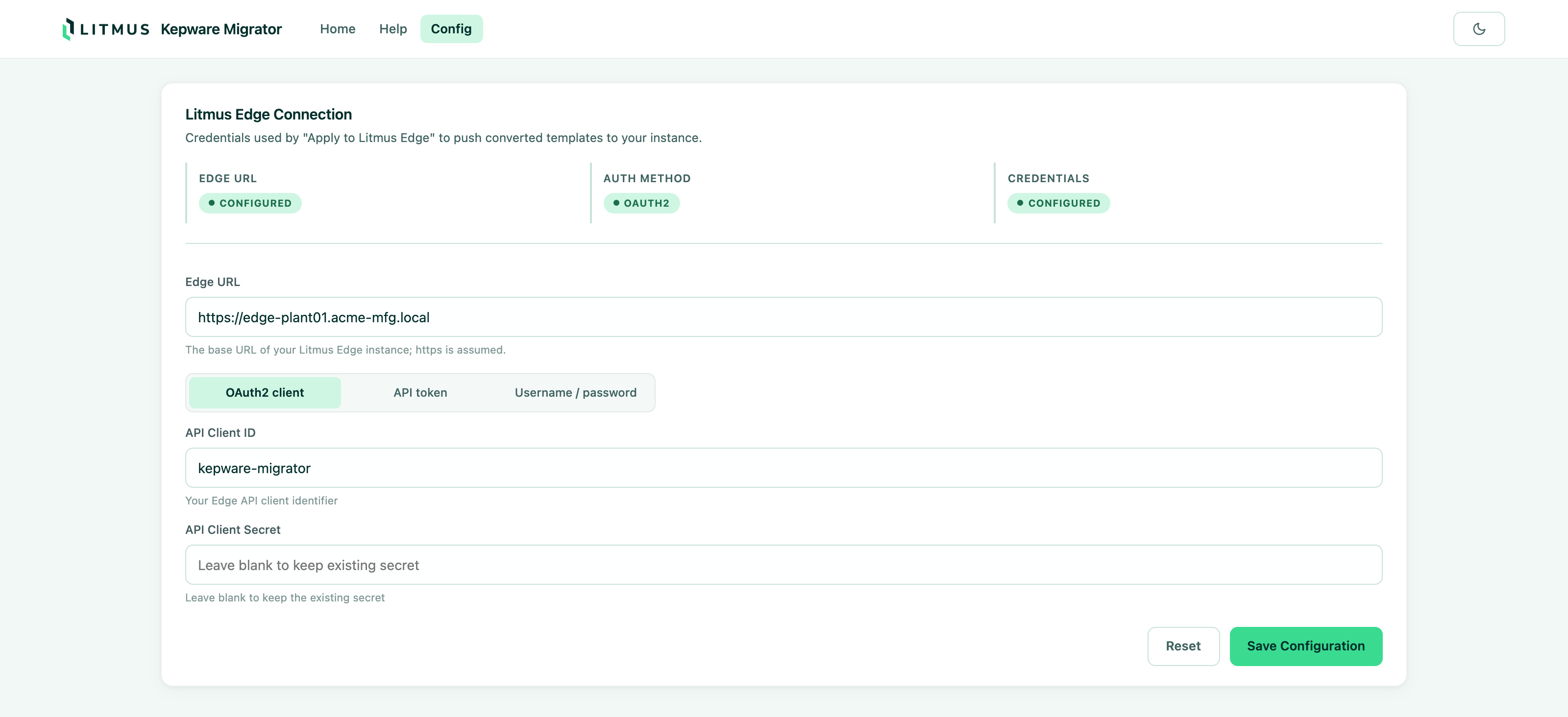
- Click the Config tab in the migrator interface
- Enter the Edge URL (e.g., 192.168.1.100 or https://edge.example.com). If you leave out the scheme, HTTPS is assumed.
- Choose an authentication method and enter its credentials:
- OAuth2 client: API Client ID and API Client Secret
- API token: an API token (or JWT) generated in LitmusEdge
- Username / password: a local LitmusEdge user
- Click Save Configuration. The status row at the top of the page shows Configured once the URL and credentials are set.
- Return to the Home page
- In the "Processed Files" section, click "Apply to Litmus Edge"
Warning: Applying a template replaces the DeviceHub configuration on your LitmusEdge instance, and devices and tags not in the template are removed. Back up your current configuration before proceeding.
Option B: Manual Upload
- Log in to your LitmusEdge interface
- Navigate to System > Device Management > Template
- Click "Upload Template"
- Select the downloaded JSON file
- Review and test the imported configuration
Troubleshooting
Port Already in Use
If port 4001 is unavailable, map to a different port:
docker run -d -p 8080:4001 --name kepware-migrator \
  us-docker.pkg.dev/litmus-customer-facing/litmus-solutions/kepware-migrator:latest
Access the application at http://localhost:8080
Migration Produces Unmapped Addresses
Unmapped addresses indicate tags that couldn't be automatically converted, typically due to:
- Unsupported address formats
- Custom addressing schemes
- Driver-specific syntax not recognized
- Kepware data types with no LitmusEdge equivalent for that address
These addresses are listed in the migration log and require manual configuration in LitmusEdge.
Template Application Fails or Button Not Available
The "Apply to Litmus Edge" feature requires configuration to be set before it can be used. Verify the following:
- The Edge URL and credentials for the selected authentication method are configured on the Config page
- Configuration has been saved successfully
- LitmusEdge credentials are correct
- LitmusEdge instance is accessible from the migrator container
- You have a valid LitmusEdge license
- Network connectivity exists between the migrator and LitmusEdge
If applying the template fails with an authentication error, navigate to the Config page and check your LitmusEdge credentials.
Upload Fails
Ensure:
- File is in JSON format (not .opf or other Kepware format)
- File size is under 16MB
- JSON is valid and not corrupted
- File was exported from Kepware (not manually created)
Use Cases
Migrating Legacy Kepware Systems
Organizations transitioning from Kepware to LitmusEdge can accelerate migration by automatically converting existing configurations, preserving years of device and tag definitions while adapting to the new platform.
Multi-Site Deployments
For companies deploying LitmusEdge across multiple facilities with similar equipment, convert a single Kepware reference project and replicate the configuration across sites with minimal manual work.
Batch Processing Multiple Projects
Process multiple Kepware projects sequentially, download all converted files, and review unmapped addresses across projects to identify common manual configuration patterns before deployment.
Best Practices
- Backup Original Files: Always retain copies of original Kepware projects before migration
- Review Unmapped Addresses: Carefully examine the migration log for unmapped addresses and plan manual configuration
- Test Incrementally: After importing to LitmusEdge, test device connections one at a time
- Verify Device Settings: Review timeouts, polling rates, and communication parameters in LitmusEdge post-migration
- Download Migration Logs: Keep migration logs for reference during troubleshooting and future migrations
Limitations
- Only Kepware JSON format is supported (not .opf binary format)
- Drivers not in the supported list require manual configuration
- Tag grouping within devices may be flattened depending on driver type
- Some device-specific parameters may require manual adjustment after import
- Template application requires valid LitmusEdge license